
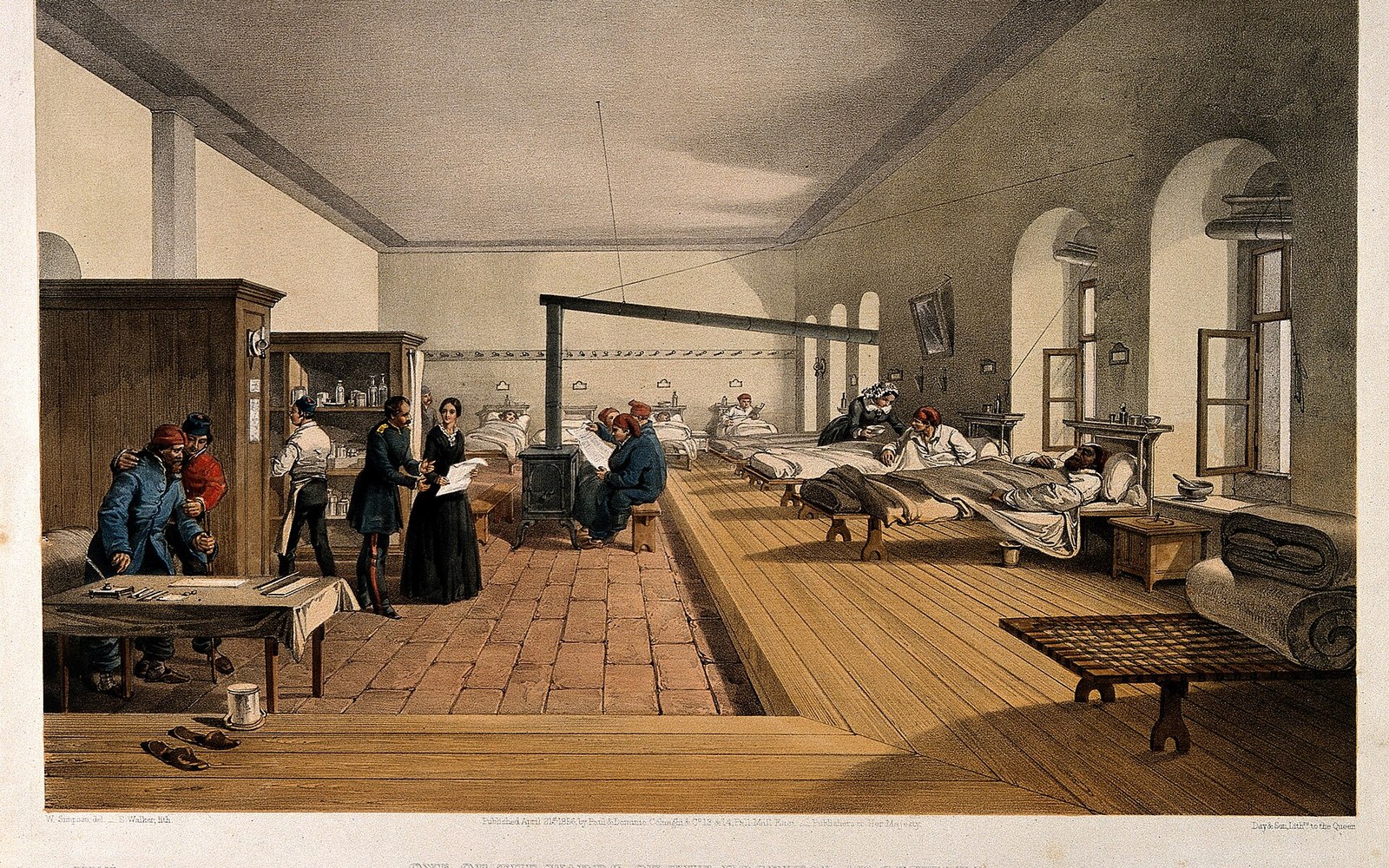
For half a century, the hospital was built around a theory of disease that turned out to be wrong. Miasma — the idea that foul air carried contagion — had given the pavilion plan its logic: separate the wards, thin the building to one room's width, open every window, and keep the air moving. Every dimension Florence Nightingale published in Notes on Hospitals in 1859 was calibrated to move air past a sick body and away. The ceiling was tall so the volume could dilute the threat. The ward was long and narrow so a cross-breeze could run the length of it without obstruction. The plan was, in the most literal sense, a ventilation machine.
Then the mechanism was found, and it had nothing to do with air.
Robert Koch identified the tuberculosis bacillus in 1882. Louis Pasteur had already established germ theory's framework through the 1860s and 70s. Joseph Lister had put antiseptic technique into surgical practice from the late 1860s onward. Each of these findings narrowed the same argument: infection was not a property of bad air but of specific living organisms, transmitted by contact, by contaminated instruments, by unwashed hands. The pavilion's entire rationale — the orientation, the spacing, the obsessive cross-ventilation — rested on a threat that microbiology was quietly reclassifying.
This did not immediately change the buildings. Institutional and intellectual inertia is slower than a journal paper, and many pavilion hospitals were still under construction into the 1890s and beyond. The Johns Hopkins Hospital in Baltimore, which opened in 1889, was designed by John Shaw Billings around ventilation calculations made before germ theory had fully settled the argument. Its pavilion blocks stand as evidence of how long the planning process lagged behind the laboratory. Buildings commissioned on miasmatic grounds were being occupied in a world that had moved on.

But once the new framework was accepted, the constraints dissolved one by one. There was no longer a medical reason to keep the ward narrow. The ceiling did not need to be fourteen feet high to provide the cubic footage per bed that ventilation formulae demanded. The gap between pavilion blocks — maintained so that foul air exhaled from one ward would not drift into another — could be closed. The hospital, freed from the obligation to bleed its own warmth into the open air, was free to become compact.
Compactness had always been administratively attractive and financially uncomfortable to resist. Heating a building designed to leak was expensive, staffing long thin corridors was inefficient, and the distances between pavilions made the logistics of a large institution genuinely unwieldy. What had prevented compactness was not preference but theory. Once theory changed, the practical pressures that had been overridden for decades could finally win.
Louis Pasteur had already established germ theory's framework through the 1860s and 70s
The result, across the first decades of the twentieth century, was a gradual thickening of the plan. Wards grew wider. Buildings grew taller. Corridors were enclosed and interior spaces multiplied. The nurse's station, once positioned at the end of a long open Nightingale ward with clear sightlines to every bed, began migrating toward the centre of more complex geometries. The window — formerly a medical instrument delivering the cross-ventilation on which lives arguably depended — became, more neutrally, a source of light and view. Mechanical ventilation, when it eventually arrived, could substitute even for that.
Germ theory did not cause the sealed tower directly. Several decades and a set of enabling technologies — the lift, ducted air handling, fluorescent light — stood between Koch's paper and the deep-plan hospital block. But it removed the intellectual prohibition. Before 1882, building a compact multi-storey hospital meant choosing efficiency over patient safety. After it, there was no longer a coherent argument that the shape of the building was the shape of the cure. What had been a medical instrument became real estate, and real estate logic, given time, tends to win.